Bio-scouring Enzyme Solution Is Beneficial to Increase the Bleaching Efficiency on the Pre-Treatment Wetting Process
By Baico Biotech 丨 Textile Enzyme 丨 BIO-SCOUIRNG ENZYME 丨 BBT-PK-Isabella
In the pre-treatment process of cotton fabrics, fabric whiteness not only affects the appearance quality, butalso directly influences the brightness of subsequent dyeing and color consistency. Many dyeing mills have found that even increasing the amount of bleaching agent does not significantly improve whiteness. The root causeis often that natural impurities have not been completely removed.
Raw cotton contains large amounts of natural impurities, including pectin, wax, cottonseed hull residues, and other natural impurities. These impurities cover the fiber surface, preventing bleaching agents from fully contacting the fibers and easily causing uneven bleaching, localized yellowing, or insufficient whiteness. Therefore, achieving efficient and uniform scouring before bleaching is the key to obtaining high-whiteness fabrics.
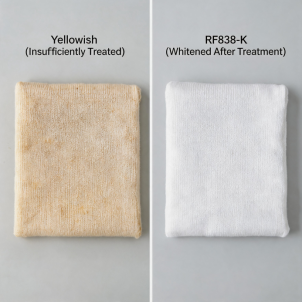
RF838-K is a bio-scouring enzyme based on alkaline pectinase. Under near-neutral conditions,RF838-K can efficiently degrade pectin in cotton fibers while promoting the removal of wax and other natural impurities. This makes the fiber surface cleaner, improves the wett ability and water absorbency of the fabric, and creates favorable conditions for subsequent bleaching. After treatment with RF838-K, bleaching agents such as hydrogen peroxide can penetrate into the fibers more evenly, improving bleaching efficiency and reducing whiteness unevenness. Meanwhile, thet horough removal of natural impurities provides a cleaner and more uniform fabric surface for light-colored and bright-colored dyeing.
RF838-K not only helps improve bleaching uniformity, but also reduces chemical consumption,minimizes fiber damage, and maintains a soft fabric hand feel. It is an effective choice for green pre-treatment processes of modern knitted cotton fabrics.
#pectinase #textile #granular #liquid #enzyme #bioscouring #concentrated #whiteness #kintting #cotton #deying #